The Word Natural Cannot Explain an Ingredient
Natural on a food label does not identify an ingredient’s source, makeup, or purpose. Learn which package details can answer those questions.
“Natural” on a food package does not tell you what an ingredient is made from, where it came from, or what it does in the food. To understand an ingredient described as natural, look for its specific name, the surrounding ingredient list, and any explanation elsewhere on the package.
What does “natural” tell you about an ingredient?
By itself, “natural” is a broad description, not a complete account of an ingredient. It may suggest that a product or component has some connection to sources people associate with nature, but it does not identify the material or explain how it became part of the food.
That leaves important questions unanswered. A label using the word does not, on its own, specify a plant or animal source, the ingredient’s composition, how it was processed, or the function it serves in a recipe.
The word can also describe different things in different places on a package. A front-panel claim may refer to the overall food, while a nearby phrase could refer to flavor or another feature. Read the exact wording and its placement rather than assuming the description applies to every ingredient.
Why doesn’t the word identify an ingredient’s source?
Ingredients can originate in many raw materials, and a broad description does not name which one was used. “Natural flavor,” for example, identifies a type of flavoring description, not the particular source or the full formula behind it.
Even when a source is named, that does not necessarily explain the ingredient’s final form. A material may be extracted, blended, dried, or otherwise processed before it appears in a food. The label’s specific ingredient name is a better starting point than a general impression created by “natural.”
Nor does the word settle questions about sourcing that may matter to you, such as where a raw material was grown or how it was obtained. Look for an explicit origin statement or sourcing detail if the package provides one; do not treat “natural” as a substitute for that information.
What can the ingredient list tell you?
The ingredient list gives you named components to interpret rather than a broad claim to guess from. Start by locating the exact term that seems unclear, then read the words immediately around it. A descriptor may be attached to a particular ingredient, while the rest of the list describes other parts of the food.
Names vary in how much they reveal. “Cocoa powder” points to a recognizable material; “natural flavor” is less specific about its source. Neither name alone tells the whole story of how the food was made, but the wording helps you see what the package does and does not identify.
Check the rest of the package for a glossary, an explanatory note, or a named source. These details can add context, but they should not be assumed to appear. If the information you want is absent, the honest reading is that the package has not supplied it.
Does “natural” mean minimally processed or healthier?
No. The word alone does not describe the amount or kind of processing an ingredient underwent, and it does not establish a food’s nutritional quality. Those are separate questions that need their own details.
If processing matters to your choice, look for a clear description of the process or a specific ingredient identity, rather than inferring a production method from a broad claim. If nutrition is your concern, check the nutrition information and the ingredients relevant to that concern. A natural-sounding phrase cannot replace either kind of information.
It is also not useful to spend time trying to infer a precise formula from a vague phrase. If the package does not name a source or provide a definition, guessing from the word alone will not make the ingredient clearer.
How can you read a natural-sounding claim carefully?
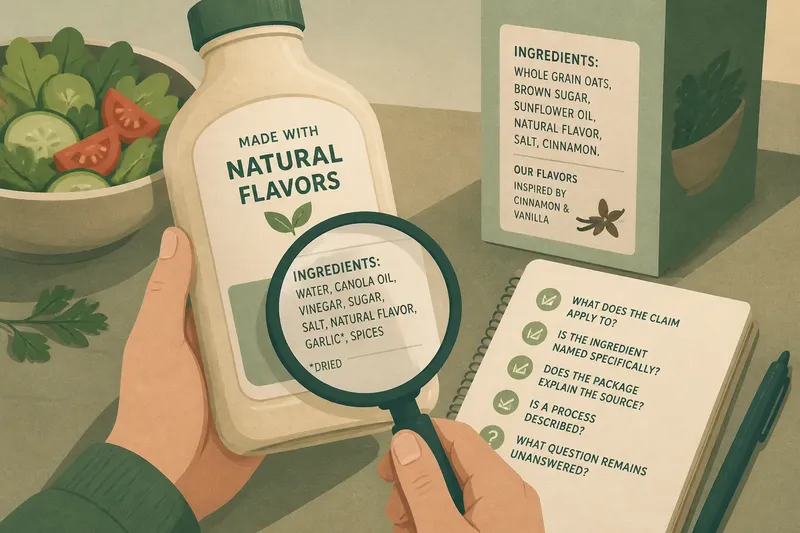
Read from the claim back to the particular detail you want to know. Say you are choosing a bottled dressing and the front says “made with natural flavors.” You want to know whether a particular herb provides the flavor. The phrase does not name the source; checking the ingredient list and any flavor explanation may give you more information, while an absent detail remains unknown from that package.
A practical reading can focus on a few questions:
- What exactly does the claim modify? Check whether it refers to the whole product, a flavor, or a named ingredient.
- Is the ingredient named specifically? Note whether the label gives a recognizable material or only a broad term.
- Does the package explain the source? Look for an explicit source statement rather than inferring one.
- Is a process described? Separate an actual process explanation from assumptions based on “natural.”
- What question remains unanswered? Identify whether you need information about composition, purpose, or sourcing before deciding.
These questions keep the reading tied to the decision in front of you. They do not require you to decode an entire label when you only need to understand one ingredient.
What do shoppers ask about “natural” ingredients?
Does “natural flavor” name the flavor source?
No, the phrase does not name a particular source by itself. Look for an additional explanation on the package if you need to know which source was used.
Can “natural” tell me how an ingredient was processed?
Not on its own. A processing method needs to be stated separately; the general description does not specify the steps or final composition.
Does “natural” mean a food has no additives?
The word alone does not establish that. Read the ingredient list for the components named on the package instead of treating the front-panel claim as a complete inventory.
What if I need more detail than the package gives?
Check for a manufacturer’s ingredient explanation or contact the company with a specific question. If no source, composition, or process is stated, treat that point as undisclosed rather than filling the gap with an assumption.
Which package detail should guide your decision?
Choose the detail that matches what you care about: an ingredient name for identity, an explicit source statement for origin, a process description for how it was made, or nutrition information for nutritional questions. “Natural” may be part of the package’s wording, but it cannot answer all of those questions at once.
When you search for the meaning of a natural food ingredient, use the phrase as a prompt to inspect the specific package details, not as the answer itself. That distinction lets you make a decision based on what the label actually says—and recognize clearly what it leaves unsaid.