Per Serving or Per 100 Grams: Two Ways to Compare a Label
Per serving or per 100 grams: learn to compare nutrition labels fairly, adjust for the amount you eat, and avoid letting package serving sizes mislead you.
To compare nutrition labels fairly, match the amount of food each panel describes before comparing its numbers. A per-serving figure tells you about a stated portion; a per-100-gram figure gives you a fixed weight. Neither automatically describes what you will eat, so the useful comparison depends on your purpose and the amount you expect to have.
What does each nutrition panel describe?
A serving-based panel lists nutrients for a manufacturer’s defined serving. That serving may be a count, such as two crackers, or a weight, such as a portion of cereal. It helps translate the panel into a familiar eating occasion, but it is a reference amount, not a rule about what belongs on your plate.
A per-100-gram panel reports nutrients for the same weight across products. It is useful when packages use different serving sizes or when you want to compare foods by weight. Because it describes a fixed quantity, you still need to account for how much of each food you actually eat.
Labels may show one format, the other, or both. The units matter: grams of food are not the same as grams of a nutrient. Read the column heading and the unit beside each value before making a comparison.
Which amount should you use for the comparison?
Start with the question you want the label to answer. If you are choosing between two products for a similar snack, compare the amounts you would plausibly eat. If you are comparing how concentrated their nutrients are, use the per-100-gram figures.
- For a typical portion: compare per-serving numbers only if the servings represent amounts you would actually eat. If not, adjust both products to a shared amount.
- For equal-weight comparison: use per-100-gram values, or convert both labels to another shared weight.
- For a whole package: work out how much is in the package and scale the figures to that quantity, rather than treating one listed serving as the entire package.
Keep the comparison focused on the nutrient you care about, such as sodium, fiber, or added sugars where listed. A food is not “better” in every respect just because one number is lower; the relevant choice depends on what you are comparing and how the food fits into your eating pattern.
How do you make the numbers like for like?
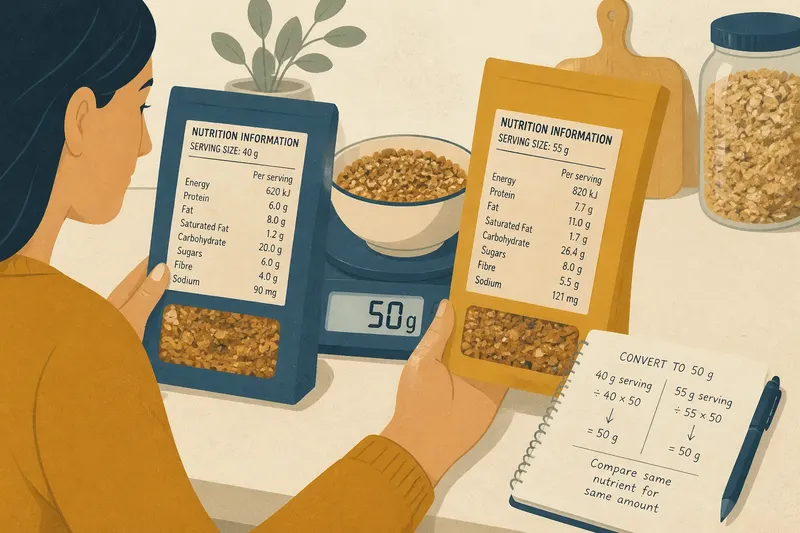
If the labels use different serving weights, convert them to a common amount. To estimate a nutrient amount for a portion, divide the label’s nutrient figure by the serving weight, then multiply by the weight you plan to eat. This arithmetic assumes the label’s figures scale proportionally across the amount; treat the result as an estimate, not a more precise label value.
For a per-100-gram panel, multiply each listed nutrient by the number of grams you plan to eat and divide by 100. For a serving-based panel, use the same method with the serving weight as the starting point. If the serving is described by count but its weight is not available, use the package’s stated count and serving information where possible; avoid pretending that unlike pieces have an exact shared weight.
Imagine you are choosing between two granolas for a bowl, and one serving is listed as 40 grams while the other is 55 grams. You plan to use 50 grams of either. Convert each label’s nutrient values to 50 grams by dividing by its serving weight and multiplying by 50; then compare the resulting estimates for the nutrient you care about. The comparison now reflects the same amount of food rather than two different suggested portions.
If you do not know how much you usually eat, you do not need to weigh every meal. Use a familiar household measure or a portion you can reproduce, and treat it as an estimate. The point is to avoid comparing one small portion with a larger one as though they were equivalent.
What can make a comparison misleading?
A serving name can sound familiar while its weight differs between products. “One bar,” “one cup,” and “one slice” are not necessarily comparable amounts. Check the gram weight when it is provided, especially when pieces vary in size or density.
Rounding can also make close figures look identical or slightly different. A calculated value derived from rounded label numbers cannot recover detail the panel does not show. Use the figures to understand broad differences, not to claim a tiny distinction is exact.
Pay attention to whether the product is prepared as sold or prepared according to directions. A panel may describe dry cereal, a mix before liquid is added, or a prepared food. Compare panels that describe the same state, and do not assume that water, milk, or another addition is included unless the label says so.
Not every label gives a per-100-gram column, and some foods are awkward to compare by weight because the usual amount is counted or measured another way. It is not worth calculating elaborate conversions when the portion weights are missing or the numbers are rounded too heavily to support the distinction you are trying to make.
What label questions help with this comparison?
Does a serving size mean I should eat that amount?
No. It is the amount used for the panel’s serving-based figures, not a personal recommendation. Decide what amount fits your appetite and situation, then use that amount for a fair comparison.
Is per 100 grams always the more useful column?
No. It is especially handy for comparing nutrient concentration across unequal serving sizes, but it may not reflect the portion you eat. For an eating occasion, a shared realistic portion can answer the more relevant question.
Can I compare a count-based serving with a gram-based one?
Yes, if the label provides enough information to connect the count to a weight, or if both products can be compared at a shared count that represents similar amounts. If neither is possible, describe the comparison as approximate rather than treating the portions as equal.
What if one panel lists a nutrient and the other does not?
You cannot make a direct numerical comparison for a nutrient that is absent from one panel. Check whether the package provides the information elsewhere, and otherwise keep the comparison to nutrients both labels report.
How do you use the comparison at the shelf?
Read the amount first, choose the basis that fits your question, and then compare the same nutrient for the same quantity. If the serving weights differ, use the shared-weight calculation; if the panels already provide per-100-gram values, use those for a concentration comparison. Finish by checking that both products are described in the same prepared state.
For a quick decision, write down the one or two nutrients that matter to your choice and ignore unrelated figures for the moment. If two foods differ in serving size but their per-100-gram values are close, the portion you choose may matter more than the label’s suggested serving. If the concentration differs, your usual amount still determines how much you take in.
Per serving or per 100 grams is not a contest between a “right” and “wrong” column. Per-serving values connect the label to a stated portion; fixed-weight values make products easier to compare on equal terms. The most useful number is the one recalculated, when needed, for an amount you can actually picture eating.
When package directions or local labeling rules affect what a panel includes, follow the information printed for that product rather than assuming every format works alike. Once you have matched the quantity and product state, the comparison becomes a practical aid—not a judgment about what anyone should eat.