From Grain to Flake: How Rolled Oats Are Processed
Rolled oats processing turns oat groats into familiar flakes. Learn what cleaning, hulling, steaming, rolling, and drying change—and how those steps affect cooking.
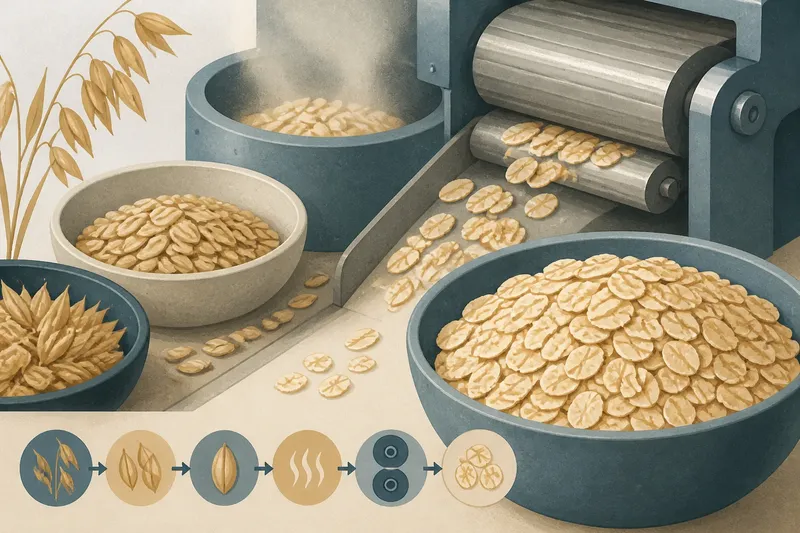
Rolled oats processing turns an oat kernel into a flake without milling the whole grain into flour. Cleaning, hulling, steaming, rolling, and drying each change the grain’s form or handling, which helps explain why oat products cook differently.
What happens before an oat is rolled?
Oats arrive at a mill enclosed in a tough outer hull, which is not the part usually eaten. Cleaning equipment separates the grain from unwanted material such as dust, small stones, and stray plant matter before the oats reach the machines that prepare them.
The cleaned oats are conditioned to help loosen the hull. Hulling equipment separates that outer covering from the groat, the edible kernel. In a groat, the bran and inner parts remain together rather than being milled apart.
Steel-cut oats are made by chopping groats into pieces. Rolled oats generally use groats kept whole or close to whole, so the kernel can be pressed into a recognizable flake.
Why are groats steamed before rolling?
Steam warms and softens the groat, making it more pliable under pressure. Heat treatment also reduces the activity of enzymes that can affect the grain’s fats; mills commonly call this stabilization.
Stabilization is a processing step, not the addition of a preservative. The exact sequence and conditions vary by mill and product, so a package usually cannot reveal the specific method used.
How does rolling change the grain?
After steaming, groats pass between rollers that flatten them into flakes. The rollers change the kernel’s shape and thickness but do not turn it into powder.
Flake thickness and size influence how readily liquid softens oats. Thinner or smaller pieces often soften sooner, while thicker flakes may hold more structure during cooking. The result also depends on the product and how it is prepared, so these are tendencies rather than a promise about every bowl.
Regular rolled oats are often sold as old-fashioned oats. Quick oats are commonly cut into smaller pieces, rolled thinner, or both. Instant oats are designed to soften readily; some products include ingredients beyond oats, so check the ingredient list when that distinction matters.
Why are rolled oats dried after rolling?
Drying removes moisture left by processing and prepares the flakes for handling and packaging. The flakes are then cooled and inspected. A package may contain only oats or list additional ingredients, depending on the product.
Drying does not make oats immune to moisture or odors after opening. Keep the package closed in a dry cupboard and follow any storage directions on the label.
What should you check when choosing oat flakes?
- Check the product name for regular, quick, or instant oats; if you want a more distinct flake, choose regular rolled oats, and if faster softening matters more, consider quick or instant oats.
- Check the ingredient list for additions; if you want oats alone, choose a package listing oats as its only ingredient, and if other ingredients suit your needs, compare their names.
- Check the flakes through the package when visible; if most look intact, expect a more recognizable flake texture, and if they appear heavily crushed, choose another package or use the fragments in baking.
- Check the cooking directions; if they match the time and method you can use, follow them, and if they do not, select a product with directions better suited to your routine.
- Check the recipe if you are baking; if it specifies a type of oat, use that type, and if you substitute another, expect the texture or liquid absorption to differ.
- Check the storage directions and the package condition; if the seal is intact and the directions suit your cupboard, store it as instructed, and if the package is damaged or the flakes show moisture, choose another product.
Why do oat flakes cook or look different?
Why do rolled oats cook softer than expected?
Thin flakes, small fragments, or extra cooking can make oats softer. Try a thicker flake or check the texture sooner, following the package directions.
Why do flakes look dusty or broken?
Some fragments can form as flakes move through processing and packaging. If most of the package is crushed, choose another package; a few fragments alone do not show that the oats are a different grain.
Why do rolled oats take longer than quick oats?
Regular rolled oats may be thicker or larger, so they can take longer to soften. Compare the package directions and choose quick oats if you want a product designed to soften sooner.
What should I do if oats smell unusual?
An unusual rancid odor or visible moisture can be a reason not to use the oats. When in doubt, discard them and follow the package’s storage guidance for the next container.
How do the main oat types differ?
Regular rolled oats are flattened groats; steel-cut oats are groats chopped into pieces; quick oats are generally smaller or thinner flakes; and instant oats are made to soften readily. These names describe broad product types, not every detail of a mill’s process.
Say you have a recipe calling for regular rolled oats, but your cupboard holds quick oats. The starting point is one recipe and one package labeled quick oats. Read the package directions, then use the quick oats in the recipe; the likely tradeoff is a softer, less distinct texture, so if the recipe depends on clearly defined flakes, get the specified type instead.
It is not worth trying to infer a mill’s exact roller settings or steam conditions from a flake’s appearance. Those details vary, while the useful distinction for cooking is usually whether the oats are whole groats, cut pieces, rolled flakes, or a faster-softening product.
Are rolled oats whole grain or raw?
Are rolled oats whole grain?
Rolled oats are generally made from groats that are steamed and flattened, rather than separated into refined parts. Check the ingredient list to see whether the package contains anything besides oats.
Are rolled oats raw?
Ordinary rolled oats are heat-treated during processing, including steaming. They are not untreated kernels, even when oats are the only listed ingredient.
Are steel-cut and rolled oats made from the same grain?
Both come from oat groats. Steel-cut oats are chopped into pieces, while rolled oats are pressed into flakes.
Do all rolled oats need to be cooked?
Some oats soften in liquid without cooking, but texture and recommended use vary by product. Follow the package directions, especially when preparing food for someone with specific dietary or food-safety needs.
To understand rolled oats processing, follow the grain’s changing form: cleaning removes unwanted material, hulling exposes the groat, steaming softens it, rolling flattens it, and drying prepares the flakes for packaging. That sequence explains both the familiar flake shape and why different oat products behave differently in a bowl or recipe.